
Thermal springs, sanatorium light, and longevity clinics from Lake Geneva to the Valais — matched to what each undoes.
Longevity is the Alps’ original business. The ski season is the newcomer: until a St. Moritz hotelier talked his summer guests into a first December in 1864, the mountains’ trade ran in summer, and what it sold was recovery — water cures, air cures, sun cures, whole towns founded by doctors and financed by the convalescent. Today’s longevity clinic, charging five figures for a week of diagnostics, is not a new industry that picked a scenic backdrop. It is the third act of the oldest one in the range, and between Lake Geneva and Lake Lucerne all three acts are still taking guests.
The record starts early. In 1242, hunters from Pfäfers Abbey found a spring in the Tamina Gorge running at exactly body temperature, and within a century the sick were being lowered into the ravine in baskets on ropes to soak for weeks where the water met the rock. Paracelsus wrote a book on that spring in 1535. In 1789 a French aristocrat out walking above Lake Geneva took to drinking daily from a garden fountain at Évian, credited the water with his recovery, and set off the cure that renamed the town. Then came the air: in the 1890s a Geneva tuberculosis specialist named Théodore Stephani put numbers to a Valais plateau called Montana — some 2,200 hours of sun a year, high, dry, and still — and began sending patients up; sanatoria followed there and at Leysin, Arosa, and Davos, towns purpose-built for lying in the light. Katherine Mansfield wrote at Montana in 1921, and the twenties called the plateau the pearl of the Alps. Antibiotics closed that chapter after the war, but the towns kept their sun, their rail lines, and their habit of receiving the unwell — and in 1931, at Clarens on the lake below, a doctor named Paul Niehans opened a private clinic on the premise that aging itself could be admitted and treated. Every wellness retreat in the range descends from one of these three lines.
Which line to book is the real decision, because the three schools do different work. The water school treats the body that has been used hard — joints, circulation, the accumulated year — and asks the least of its guests. The air school treats depletion: sleep, stress, a burned-down nervous system, met with altitude, cold, and light, treatments in support. The clinic school treats habits and unknowns; it measures first, intervenes second, and asks for obedience by the week. The addresses that follow are where each school still does its best work.
When to Take the Waters
The cure predates the seasons, so it largely ignores them. The clinics run year-round at flat program prices while the resort towns around them open and close, which makes the gaps that empty the winter valleys — November, and late April to mid-June — the cure’s natural weeks: nothing on the mountain to miss, and a house’s full attention to receive. Where the calendar does bite, it bites specifically. The baths at Brides-les-Bains run from spring to late October and close for the ski months. At the resort addresses — Évian, Bad Ragaz, Crans-Montana — the medicine is priced flat but the rooms move with the season, so a shoulder-week reservation buys the same treatment schedule in a quieter house at a softer room rate. The mechanics matter too: Clinique La Prairie admits by the week, Sunday to Saturday, which makes each named Sunday the thing to reserve; Chenot runs seven nights wherever they fall; the resort spas set their own start days. Spring and autumn are the deep-program high seasons by the houses’ own account — reserve those first.
Grand Resort Bad Ragaz and the Tamina Gorge
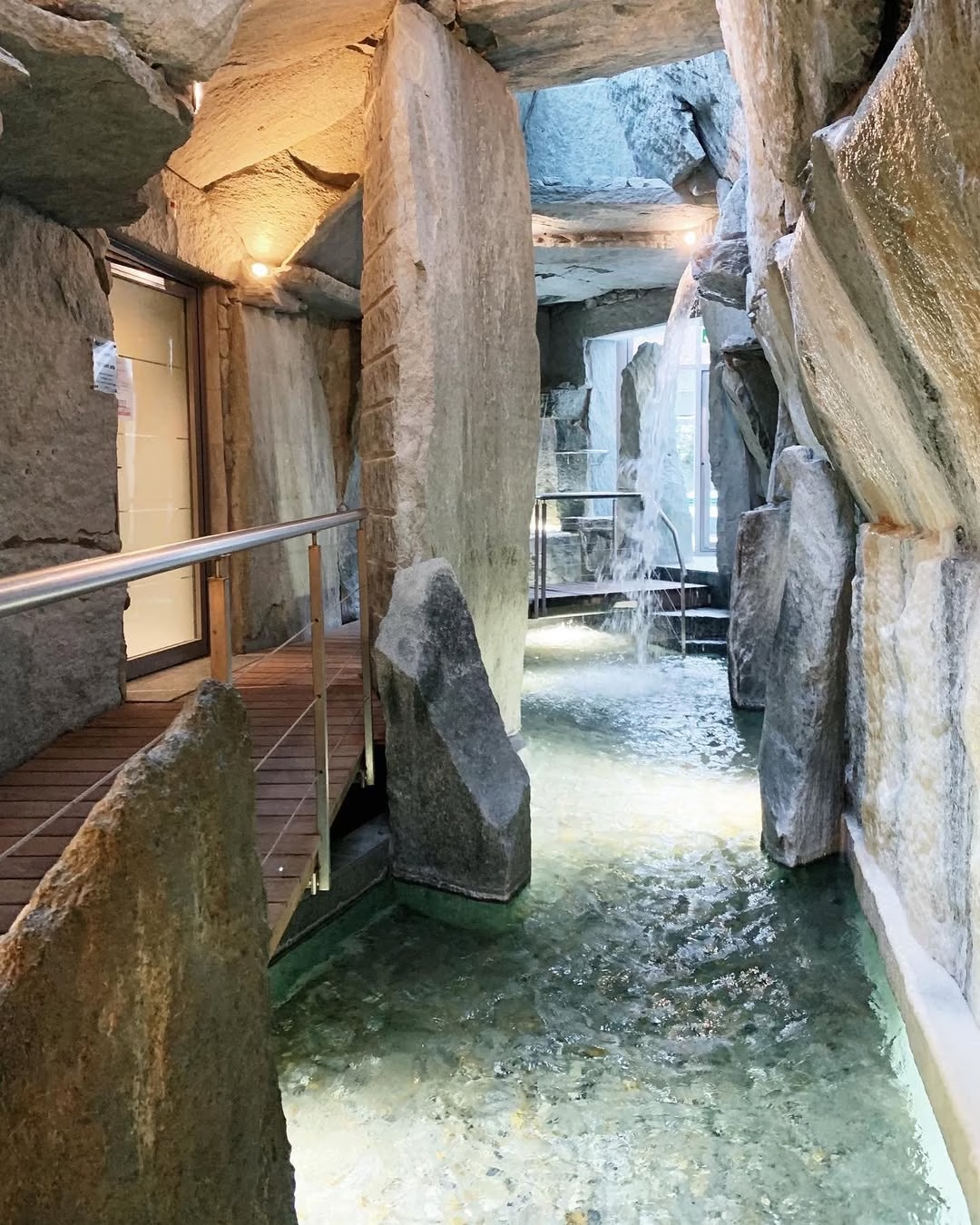
The oldest cure in the range still arrives at body temperature. The spring the Pfäfers hunters found in 1242 runs at 36.5 degrees, low in minerals and constant to the decimal, and since 1840 it has traveled four kilometers of pipeline into Bad Ragaz, where it fills thirteen pools across a two-hotel estate without ever being heated, cooled, or dosed. That estate — the Quellenhof of 1868 and the quieter Hof Ragaz — is the water school at full scale: a medical center founded in 1957 with some seventy doctors and therapists on campus, Michelin-starred dining, two golf courses, and the rare arrangement in this company where a cure and a holiday can share a roof. One guest can run a supervised program while the other plays thirty-six holes and meets for dinner; children have a spa of their own. Book the Quellenhof, take the medical assessment on the first morning, and let the water do the repetitive work — the daily soak is the prescription eight centuries kept renewing. The gorge itself remains the argument: a walkway runs 450 meters into the rock at Old Pfäfers, past the baroque bathhouse, to the grotto where the spring surfaces warm in the dark, on the spot where patients once soaked for weeks after arriving by rope. Anyone not ready to commit a week can taste the water first — the public Tamina Therme next door sells day entry to the same spring. What Bad Ragaz cannot write is a prescription for altitude; the town sits on the valley floor, and the mountains here are scenery rather than medicine. When the assignment is air, go up to the plateau. When it is the body’s mileage, this water has no senior.
Hôtel Royal, Évian-les-Bains
Évian is the gentle school — the cure as pleasure, run from a palace built by the water company itself. The spring came first. In 1789 the Marquis de Lessert, walking above the lake, took to drinking daily from a fountain in Monsieur Cachat’s garden and credited it with his recovery; doctors examined the water and agreed, the first baths opened in 1806, a bottling works followed in 1826, and the town appended les-Bains to its name. The mineral-water company commissioned the Hôtel Royal in 1905 and opened it in June 1909, named for Edward VII, who had promised to inaugurate it and died the following spring; the name stayed, and so did the guest list — Proust took the air here, and Garbo arrived from Hollywood in 1949. The modern reason to go opened in the summer of 2025: the brand’s first spa in Europe, 1,700 square meters sequenced entirely around water, from a therapist-led 150-minute run of hydromassage and private steam down to the plainest treatment in the range — the Cachat spring itself, a fifteen-minute walk below the hotel, emerging at a constant 11.6 degrees after fifteen years of filtration through the mountain, free to anyone holding a bottle. Between May and September the little 1907 funicular still links hotel and town. Book a lake-facing room in the main building; the length of Lake Geneva is the treatment the room administers at seven in the morning. And know the school before enrolling: nobody at the Royal confiscates a wine list. This is the cure for those who want the water, the walks, and the table too. Supervision is a different school.
Brides-les-Bains and the French Prescription
France runs the cure as medicine, with paperwork, and Brides-les-Bains is where the system does its best-known work. La médecine thermale is a national institution the English-language spa press barely registers: a physician writes an actual prescription, the standard course runs eighteen treatment days across three weeks, and the state insurance system reimburses part of the cost. Brides has been the country’s leading station for weight and for rheumatology for some 170 years, and the daily shape of a cure has barely changed — about ninety minutes of prescribed morning treatments, the drinking cure, hydromassage baths, jet showers, then an afternoon left deliberately empty in a village at 600 meters that exists for the project, dietitians and thermal doctors included. The baths were rebuilt in 2018, three thousand square meters with a spa wing, the Grand Spa Thermal, that takes the unprescribed on three-to-nine-day programs with no paperwork at all. The address is the Grand Hôtel des Thermes, a few steps from the treatment doors. What Brides is not is a palace: the register is clinical corridors, weighed portions, and sensible shoes, and that plainness is exactly its authority — this is the version of the cure that answers to the national health system rather than a marketing department. The geography is the private joke of the place: the Olympe gondola rises straight out of the village to Méribel, and Courchevel’s tables sit eighteen kilometers up the road, so the country’s strictest spa town spends every winter as the quietest doorway into the Trois Vallées. The baths run from spring to late October; a French prescription unlocks the full cure, and the short programs are open to anyone — write ahead.
Six Senses Crans-Montana
Crans-Montana was founded on a measurement. Stephani’s numbers for the plateau — the 2,200 sun hours, the dry still air at 1,500 meters, a full southern exposure — rated above Leysin’s and even Davos’s in the era’s climate studies, and his patients began arriving in 1896 at the Hôtel du Parc, where he installed central heating and the first telephone line in the Valais. The first sanatorium went up in 1899, the funicular from Sierre — then the longest in Switzerland, cutting three hours off the climb — in 1911, Mansfield and her notebooks in 1921. Antibiotics retired the sanatoria; golfers and skiers rehired the light. Then in 2023 Six Senses opened its first Alpine house here and quietly reopened the original file: 47 rooms and suites at the ski lifts, a 2,000-square-meter spa running from an indoor pool beneath fifteen thousand hanging timber battens out to open-air water, and programs of three to seven nights, each opened by a biomarker screening, that treat the plateau itself as the pharmacy — altitude, cold exposure, forest, and the south light the sanatorium balconies were built to catch. Book the Alpine Reboot at no fewer than five nights, add the wellness table at CHF 170 a day, and take a south-facing room: on the right winter morning the Rhône valley below is a floor of cloud while the plateau sits in full sun, which is the whole 130-year-old point, visible from bed. This is the air school without the clinic. Nobody here draws blood twice a day, and the depleted, as opposed to the diagnosed, are exactly who it suits.
Clinique La Prairie, Clarens
The clinic school begins at Clarens, in the house with the yellow awnings where Paul Niehans decided in 1931 that aging was a condition with a waiting room. His treatment made the address before science could examine it — injections of fetal sheep-cell extracts, a therapy medicine later set aside — and it drew the postwar world to this garden on the lake: Pius XII took the cure in the 1950s, and Churchill, Dietrich, and Adenauer came in the same decade. The modern clinic has traded the syringe for the file. A week here — Sunday to Saturday, the only unit sold — is built around the most complete medical picture most guests will ever commission: consultations and imaging across some fifty on-site doctors, genetic screening, the house’s count of three hundred tracked biomarkers, a supplement line descended from the founding extract, and a gastronomic dining room reserved for guests, its kitchen run by a Meilleur Ouvrier de France. The Revitalisation, the founding program, starts at CHF 31,800 for the week; the premium version runs toward fifty thousand; a three-day diagnostic stay starts at CHF 17,680 for those who want the picture without the program. Reserve the specific Sunday early — the calendar holds only fifty-two of them — and ask for a room in La Résidence, the original 1931 building above the French garden, where the whole enterprise began. The candor the price deserves: the certainty on sale is the file, and the file is genuinely without rival. Everything past the file is the question the house has kept open for ninety years, and guests keep returning, year after year, to ask it again.
Chenot Palace Weggis
Chenot Palace Weggis is the method school: seven nights, no exceptions, and the first two days are the hard part. The village drew admirers long before the clinic — Mark Twain, passing through in 1897, called Weggis the loveliest place he had ever seen — and the house that opened on its lakefront in 2020 is the flagship of a system Henri Chenot spent half a century refining. Admission is by program only: seven nights minimum, no shorter stay sold, outside visitors received no deeper than the tea lounge. Inside, the week runs on the Chenot Diet — three courses plated like a tasting menu and totaling 850 calories a day — a daily hydrotherapy sequence of bath, mud, and jet shower, and a treatment schedule set by the doctors at the first consultation, backed by a 5,000-square-meter medical floor with laboratories of its own. The arc is honestly front-loaded: days one and two, stripped of coffee, alcohol, and most of the calories, tend to bring headaches and a short temper, and by midweek the logic of the return guests asserts itself — the loyalty program, in which a fifteenth stay earns a full program to give away, reads less like marketing than like a census of believers. Book the full seven rather than angling for fewer, schedule nothing for arrival day, and take a lake-view room. Programs start at CHF 5,500 with rooms from CHF 410 a night, so the realistic floor for the week is about CHF 8,400 before extras. Spring and autumn are the house’s own high seasons for the deep programs; winter is the inward version, the lake in fog and nothing to regret missing.
Programs, Prices, and Booking Notes
The interseason rule. Clinic program pricing holds flat year-round; resort room rates do not. November and late April to mid-June are the range’s quiet gaps — full attention, the softest room rates, nothing on the mountain to miss. Confirm each house’s exact operating dates before reserving either gap.
Grand Resort Bad Ragaz — Medical assessments and programs bookable alongside ordinary stays; the 36.5° thermal pools are included for hotel guests. Day entry to the public Tamina Therme requires no hotel reservation. The gorge walk to Old Pfäfers operates seasonally. resortragaz.ch; taminatherme.ch.
Hôtel Royal, Évian — Rooms across several categories; lake-facing in the main building is the one to hold out for. The 1,700 m² spa opened summer 2025; the Cachat fountain in town is free; the hotel–town funicular runs May–September. evianresort.com.
Thermes de Brides-les-Bains — Season runs spring to late October; confirm current-year dates. Cure conventionnée: eighteen treatment days over three weeks, French prescription required, partly reimbursed. Short programs of three to nine days at the Grand Spa Thermal, open reservation. Stay at the Grand Hôtel des Thermes. thermes-brideslesbains.fr.
Six Senses Crans-Montana — Programs of three to seven nights with biomarker screening; wellness meal plan CHF 170 per day; ski-in, ski-out in winter; Geneva is about two and a half hours. sixsenses.com.
Clinique La Prairie, Clarens — Sunday-to-Saturday weeks, direct reservation. Revitalisation from CHF 31,800; Revitalisation Premium toward CHF 50,000; Master Detox from CHF 20,950; three-day Health Diagnostic from CHF 17,680. cliniquelaprairie.com.
Chenot Palace Weggis — Seven-night minimum, program mandatory, direct reservation. Programs from CHF 5,500 plus rooms from CHF 410 per night — about CHF 8,400 for the week before extras. chenot.com.
The winter valleys keep a different calendar — region by region and week by week in the Alpine regions guide: /travel/alpine-regions-guide/.
The three schools have divided the labor for a century, and the division holds: water for the body that has been used hard, air for the mind that has been used harder, the clinic for the questions neither can answer. The Alps still keep the oldest promise in travel — a week that returns more than it took. The spring in the gorge has held 36.5 degrees for eight hundred years, the plateau will log its 2,200 hours of sun this year without being asked, and on the lake at Clarens every week of the calendar is a Sunday with someone’s name on it. Pick the school, then pick the week. The mountains were in this trade before there were skis.