
The Alps are not visited so much as chosen. Eight valleys carry eight distinct temperaments — one built around a frozen lake and a social calendar, one around discretion itself, one around a mountain that outranks its guests, one around a table — and the difference between a good week and the week of the year is knowing which valley is keeping it.
The whole arrangement is younger than it looks. Until the winter of 1864, nobody wintered in the Alps for pleasure; the season was summer, the draw was the air and the spa water, and December belonged to the farmers. Then Johannes Badrutt of the Kulm hotel in St. Moritz made his English summer guests a wager: come back in December, and if the Engadin winter disappoints, the whole stay is refunded. As St. Moritz tells it, they crossed the Julier Pass swaddled in furs and found him waiting in shirtsleeves under a blue sky. They stayed until Easter. Winter tourism has never once paused since — and it has never stopped being what Badrutt made it: not a sport with a village attached, but a season, with rooms, tables, races, and rituals, each valley composing its own.
That is what there is to choose between. Not the mountains — the mountains are magnificent everywhere — but the societies at their feet, and the exact weeks each one comes into its voice.
When the Alps Are Most Themselves
The Alpine winter keeps theatrical hours. Early December is the overture — snow often superb, villages half-lit, some kitchens still dark from the autumn pause. Christmas through New Year is the full house: the highest rates of the year, the longest tables, the weeks the chalets were built for. Then comes the quiet mastery of mid-January, when the visitors thin, the snow is at its deepest cold-weather best, and the hotels have attention to spare — the fortnight that repays planning more than any other. February is the season at full voice: the races run, the horses take the ice at St. Moritz, and Europe’s school holidays fill every gondola. March trades depth for light — long lunches on high terraces, skiing that ends at a table in the sun. By late April the curtain falls, and the high Alps take a genuine interval: from then until mid-June, and again in November, whole villages close their doors to rest. The other season is its own reward — high-summer glaciers and rifugio nights, then October, when the larch forests turn gold and the valleys go quiet for the people who come for the light alone.
St. Moritz and the Engadin
The season’s capital, still. What St. Moritz does better than anywhere is winter as society: come February the frozen lake becomes the town square, and on three Sundays the racehorses run on it — White Turf, ice flying at the rails, fur and champagne in the grandstands, a spectacle the town treats as entirely normal. Snow polo takes the same ice in late January. Above the village the Cresta Run is rebuilt from snow and water every winter as it has been since the 1880s, its start a short walk from the Kulm — the same hotel where the bet was made, where the first electric light in Switzerland once came on in the dining room.
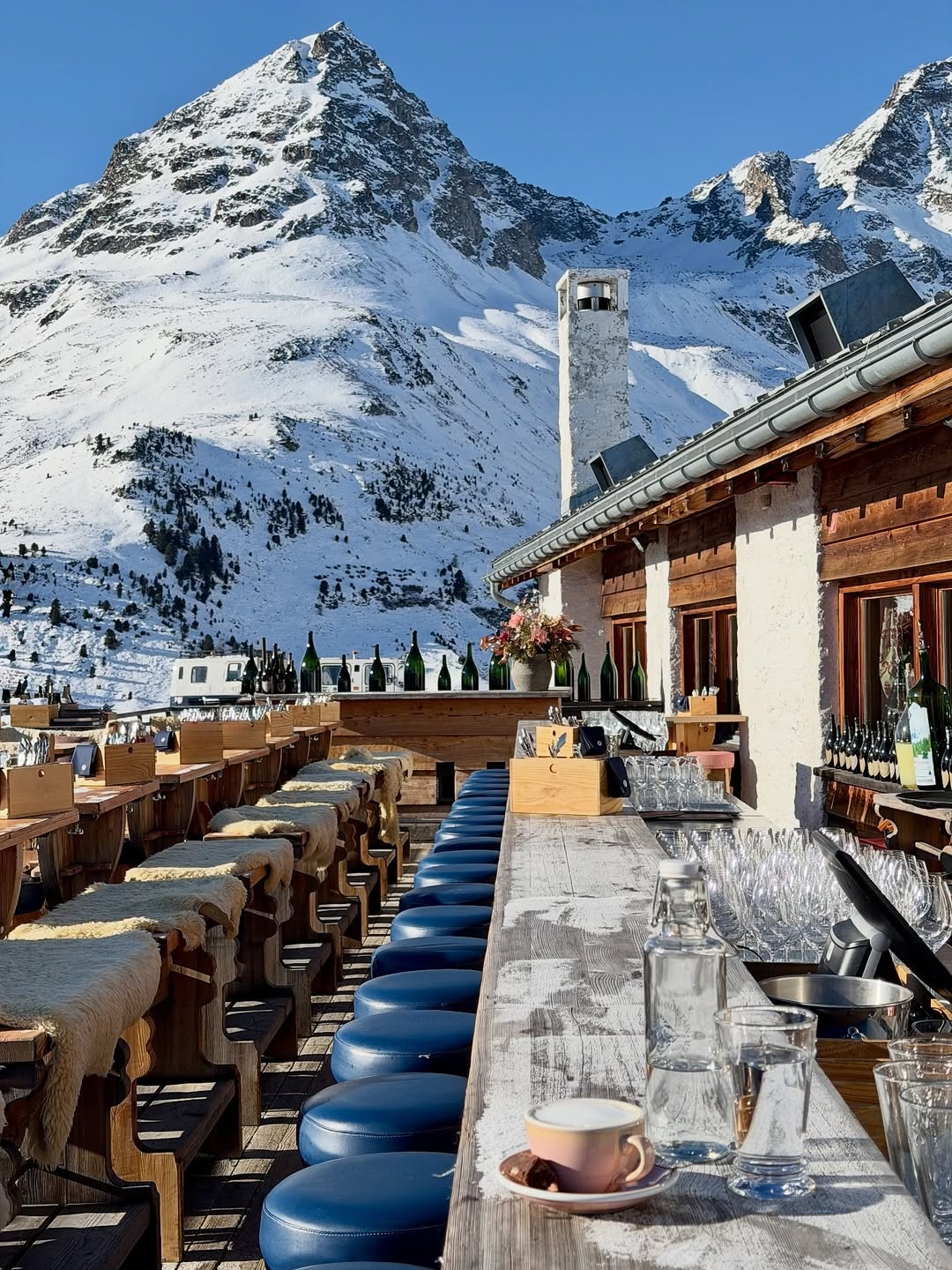
The day here is organized around lunch. Corviglia, the sunny mountainside above town, holds the highest concentration of serious mountain tables in the Alps: Paradiso at 2,181 meters, reached by chairlift and a ten-minute walk, with a cellar of five hundred wines and an entry charge for non-members at the door — a detail that says a good deal about the clientele it expects. Langosteria has carried its Milanese seafood up to the same slopes. Dinner belongs to Chesa Veglia, the old Engadin farmhouse a few steps above Badrutt’s Palace, several dining rooms under one ancient roof from pizza in the hayloft to tableside tartare — book it before arriving; the lunch rooms fill by one.
The Engadin’s second self is quieter and, to a certain temperament, finer. Down the valley at Sils and Zuoz the centuries-old houses wear sgraffito — patterns scratched through white plaster to the grey beneath — and Romansh is still spoken at the bakery. Segantini painted this light and refused to leave it. And in October the whole valley turns: the great larch forests go gold for roughly three weeks, the lifts pause mid-month, and the Engadin belongs to walkers, painters, and the low autumn sun. It is the valley’s least defended pleasure, and its most complete.
Gstaad
Gstaad answered St. Moritz by declining the contest. No palace facades, no lake spectacle — a village of dark timber chalets at 1,050 meters, where building anything but a chalet is simply not done, with a car-free Promenade at its center and cowbells within earshot of the shopfronts. The skiing across the Saanenland is gentle and scattered, and the village has never pretended otherwise; the point of Gstaad is the register — winter kept at the pace of a village that happens to hold some of the most valuable timber in Switzerland.
The deeper claim is musical. In 1957 the tourism office asked Yehudi Menuhin, newly settled in the valley, to enrich the summer with a few concerts. Benjamin Britten came early; Menuhin built his chalet and never really left; and the festival that carries his name now fills seven weeks of high summer — some seventy-five concerts this year, its seventieth season, played in the small stone churches of Saanen, Lauenen, and Rougemont and in a festival tent in Gstaad, mid-July to the first days of September. Hearing Bach in a Saanenland church while the cattle graze outside remains one of the Alps’ great unhurried pleasures — and in early September the Züglete brings those same cows down from the high pastures wearing flower crowns, which is Gstaad’s idea of a closing ceremony. Arrive the way the valley prefers: the panoramic rail up from Montreux, vineyards to pasture in ninety minutes.
Zermatt
The one Alpine town where the mountain outranks the guests. The Matterhorn was climbed for the first time in July 1865 and took four of the seven climbers on the way down when a rope broke — among them Michel Croz, one of the great guides of his century — and Zermatt has faced that mountain with a certain seriousness ever since. The town admits no cars; arrival is by rail from Täsch, and stepping onto the platform at dusk, electric taxis humming past the lit hotel fronts with the mountain black against the last light, is one of the best entrances in the Alps. In the Hinterdorf quarter, centuries-old larch barns still stand on their stone mushroom discs, built to keep the mice from the grain.
The altitude does something no other resort can match: the season never fully ends. The Gornergrat railway has been climbing to 3,089 meters for over a century, and on the Theodul glacier there is skiing in July — breakfast in the village in shirtsleeves, carving on the glacier before lunch. The lunch itself has an address: Chez Vrony, in the huddle of centuries-old barns at Findeln, 2,100 meters, twenty minutes on foot below the Sunnegga funicular. The Julen family has kept it for generations and still serves its own dried meat and alpine cheese from animals raised on these meadows, at tables facing the Matterhorn head-on. The terrace goes first every day; call at 8:30 the same morning, when the reservation line opens, and take the walk down slowly.
Lech, Zürs, and St. Anton
The Arlberg is where skiing stopped being transport and became a discipline. On the pass stands the Hospiz, a travelers’ refuge since 1386; in its parlor in January 1901, a handful of enthusiasts founded the Ski Club Arlberg, and in St. Anton the technique itself was codified and exported to the world. The snow here is famously deep and reliable, and since the lifts were joined in 2016 the Arlberg has been Austria’s largest connected ski area — some three hundred kilometers on one pass, over terrain that still sets the standard.
One lift system, two temperaments. St. Anton skis hardest and celebrates loudest — the village where the day ends in ski boots, at volume. Lech and Zürs, over the pass, keep quieter company: Zürs installed Austria’s first ski tow in 1937 and remains a handful of hotels in deep snow with hardly a shop between them; Lech is the composed village where the Dutch royal family has taken its February week at the Gasthof Post for four generations, a bond begun in 1959 — one family hosted by another for longer than most hotels last, which counts, on the Arlberg, as a recommendation. The Weisse Ring, a twenty-two-kilometer circuit of the Lech–Zürs valley, makes the case for this side in a single unhurried day on skis. The honest arrangement, for anyone who wants both: sleep in Lech, ride to St. Anton for the steep mornings, and be back across the pass before the music starts.
Kitzbühel
Old Austria’s winter town, with seven hundred and fifty years of practice at receiving company. Chartered in 1271 on the trade road toward Venice, Kitzbühel grew rich on the silver mined out of the Hahnenkamm itself — the mountain was tunneled for treasure long before anyone thought of racing down it — and the town it built is still intact: gabled, frescoed facades in faded rose and green, Gothic churches, medieval castles now operating as hotels.
One January weekend a year, the town becomes the loudest place in the Alps. The Hahnenkamm races have run since 1931, and the Streif remains the downhill against which the sport measures itself; the finish arena sits at the edge of the old town, some eighty thousand people come, and for forty-eight hours Kitzbühel is equal parts world championship and winter ball. The rest of the winter is the reversal, and the finer secret: the same mountain, raced for one weekend, spends the other months as some of the most pleasurable cruising terrain in Austria — broad, wooded, gentle-shouldered runs above a town that has returned to its own tempo. The altitude is modest and the town knows it; one of the densest snowmaking operations in the Alps keeps the pistes in order even when the valley is green. Go the week after the race, when the stands come down and the town exhales.
Cortina d’Ampezzo
Italy’s mountain drawing room, in its first winter after the Games. Cortina has held this rank for seventy years — the 1956 Olympics here were the first ever televised, and the town has conducted itself as a stage ever since, the evening walk along Corso Italia functioning as the valley’s true main event. In February 2026 the Olympics came home, and what they left behind is the most consequential rebuilding in the modern town’s history: the scaffolding of five years gone, a gondola now linking the Tofana slopes to the Cinque Torri across the valley, and a cable line rising from the town center to 3,244 meters on Tofana di Mezzo in half an hour. The winter of 2026–27 is the first chance to have the finished town without the Games’ cordons — Cortina in its best dress in a generation, at prices that rose with it.
The setting remains the argument. The Dolomites are rock as theater — pale towers that ignite at dusk in the phenomenon the Ladin valleys call enrosadira, the mountains holding rose and ember light long after the valley has gone blue. The lifts run from early December into the first days of May, a longer season than the town’s rivals, and beyond the ridges lie the Ladin valleys, where a language older than Italian is still spoken at dinner.
Alta Badia and the South Tyrol Table
The range’s table. In these valleys the eating is not the consolation for a day outdoors; it is the organizing principle. Alta Badia has spent two decades turning its ski area into a dining circuit — starred chefs sending dishes into the mountain huts along the pistes, so that the day’s itinerary is written in courses. The doctrine was born here: in San Cassiano, a kitchen renounced olive oil, lemons, and everything else the mountains cannot grow, and cooked its way to three Michelin stars on Alpine produce alone. The hotel that housed it now carries Aman’s name; the chef carried the philosophy to a textile baron’s villa in Bruneck and won the three stars again within months. Even the simplest farmhouse dinner in these valleys — barley soup, schlutzkrapfen, speck cut at the table — is served with the same conviction.
The skiing arranges itself around the Sella massif: the Sellaronda, forty-four kilometers over four passes, a full circuit of the range in about six hours that retraces the routes Ladin farmers used between valleys long before the cables came. The finer version is to stay up: the rifugi take overnight guests, and dinner in a hut above two thousand meters — the day visitors gone down with the last cable, the dining room lit, the peaks losing their color through the windows — is the Dolomites at their most complete. The rooms are few and spoken for early; the coming winter’s are largely gone by February, the most coveted huts earlier still.
Then comes autumn, which South Tyrol refuses to treat as an ending. From early October to late November the valleys keep Törggelen, the fifth season: farmhouses hang a branch over the door to signal the new wine is ready, and the form is fixed — walk first, through the gold vineyards and chestnut woods, then sit down to speck, dumplings, roast chestnuts, and cloudy Sußer that will not survive the month. It is the Alps’ best-kept calendar of all, and it asks nothing but an appetite and good shoes.
Chamonix and Megève
An hour apart, and opposite answers to the same mountain. Chamonix takes Mont Blanc seriously: its Compagnie des Guides was founded in 1821 — the world’s oldest, built after a fatal accident, with a widows’ fund and a strict rotation so that every guide shared the work — and it still sets the tone of a town that hosted the first Winter Olympics in 1924 and has never confused itself with a resort. The Aiguille du Midi cable car has been rising to 3,842 meters since 1955, and from its ridge runs the Vallée Blanche: twenty kilometers down the glacier among séracs and silence, two thousand meters of descent, skied with a Compagnie guide for about €155 a head in a small group. It is the single most extraordinary thing an intermediate skier can do on snow, and the town at 1,035 meters lives, works, and climbs year-round beneath it.
Megève was invented as the antidote. After the First World War, Baroness Noémie de Rothschild went looking for a French answer to St. Moritz, found a thirteenth-century farming village under Mont d’Arbois, and built the resort around it — a king of Belgium among the first guests, sleigh bells in the lanes ever since. The village core is medieval, the skiing is broad, sunny, and kind, and the kitchen keeps rank with anything in the Alps: Flocons de Sel, up the Leutaz road above town, holds three Michelin stars for a cuisine of lake char, mountain herbs, and things gathered close to home — book it weeks ahead, and not on a Tuesday or Wednesday, when the house rests. Rope and crampon on one side of the hour’s drive, fur blanket and sleigh on the other; the discernment is knowing which morning calls for which.
Dates and Booking Notes
The winter clock. Season roughly early December–late April. Fullest: Christmas–New Year and February (school holidays plus the event calendar). Finest value in attention and snow: mid-January. Sun and terraces: March. Interseason closures: November, and late April–mid-June — confirm hotels and kitchens before booking either shoulder.
St. Moritz / Engadin — White Turf: February Sundays on the frozen lake (whiteturf.ch); snow polo late January (snowpolo-stmoritz.com). Chesa Veglia and the Corviglia tables book ahead in high season. October larch gold: roughly the first three weeks; most lifts pause mid-month (engadin.ch).
Gstaad — Menuhin Festival, 70th season: July 16–September 5, 2026, ~75 concerts (menuhin.ch). Rail from Montreux via the MOB panoramic line.
Zermatt — Car-free; rail shuttle from Täsch. Chez Vrony: winter to late April, summer to mid-October; same-day reservations by phone from 8:30 a.m. (chezvrony.ch). Summer glacier skiing on the Theodul, mornings.
Arlberg — One pass, ~300 km, largest in Austria. Weisse Ring circuit from Lech; its race runs mid-January. Lech and Zürs book earliest for February.
Kitzbühel — Hahnenkamm race weekend: late January (hahnenkamm.com); rooms in town sell out months ahead. The quiet weeks follow immediately after.
Cortina — Lifts early December–early May (skipasscortina.com). First full post-Olympic winter: 2026–27; expect the new Tofana–Cinque Torri and town-to-summit links open, and rates above pre-Games levels.
Alta Badia / South Tyrol — Sellaronda: full day, four passes, last pass crossed by mid-afternoon. Rifugio overnights: book the winter’s rooms by January–February, the famous huts earlier. Törggelen: early October–late November across the Eisack and side valleys.
Chamonix / Megève — Vallée Blanche with a Compagnie des Guides guide: ~€155 per person in a group, season roughly late January–early May (chamonix-guides.com). Flocons de Sel: closed Tuesday–Wednesday; reserve well ahead (floconsdesel.com).
There is no best of the Alps; there is only the right valley in its right week. The bet that started all of this was won in an afternoon, on a sunny terrace, by a man in shirtsleeves — and a century and a half later the season still pays out the same way: to whoever arrives knowing what the week is for. A horse on a frozen lake, a violin in a stone church, dinner above the clouds after the cables stop. The calendar is already keeping one of those dates.